Listen
The fact
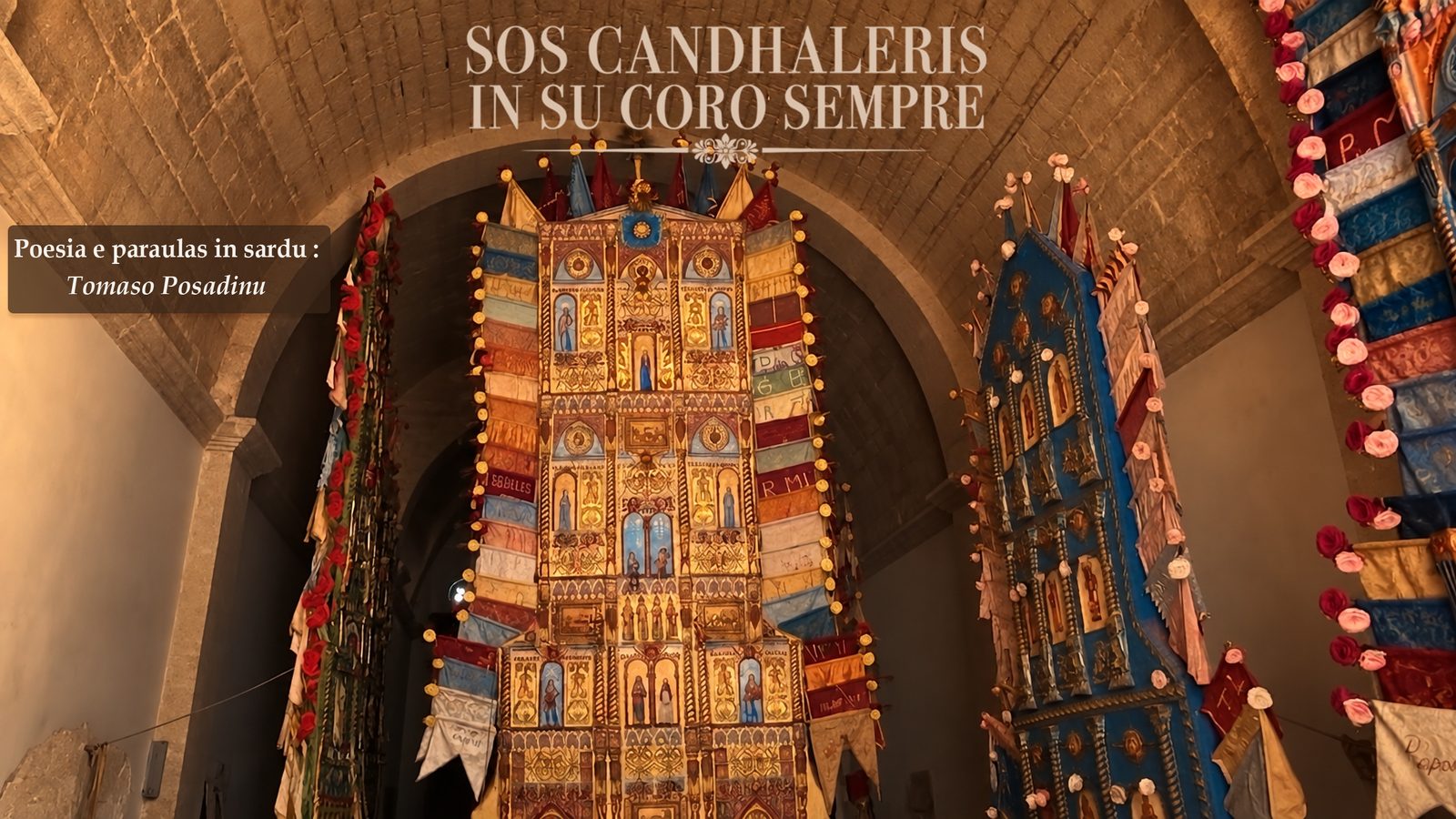
A poem by Tomaso Posadinu, a poet from Nulvi, set to music: the day of the candelieri in nine octaves, from the bell of San Filippo to the enthronement of the Assunta. The words are his, word for word; the music bends to the poem.
The lyrics
Logudorese of Nulvi
~ SOS CANDHALERIS IN SU ❤️ SEMPRE ~
Su populu aunidu in un'istante
benit a su sonu e sa campana,
chi dài Santu Filipu la sonàna
cun continu rintocu intonante,
in su mentres su fusu bogàna
dogni gremiu e, sa idda festante;
poi sighint fatu cun su tabernaculu
pro ammentu invocant su miraculu.
Pro la fagher sa prim'aparizione
in ue benint umpare afunados,
est in centru e paese s'istradone
chi si presentant bellos adornados,
totu incantados cun ammirazione
populu istranzos de fora arrivados;
su preideru prima e sa partenzia
beneighet a totu cun clemenzia.
Ogni partecipante intonàda
sinnu a Maria cun devozione,
su cabu Candhaleri eco dàda
su cumandu a ogni portadore
e totu paris faghent s'alzàda
suta sas istangas chena timore;
sa essida tand' est incominzende
e sa promissa de nou ripetende.
Maestosos e tantu imponentes
cun sas bandierinas a su entu,
faghent sa sosta in cunventu
in segus sos priores presentes,
a caddu sas bandelas ant tentu
e fatu fatu puru sos credentes;
in su patiu benint de nou calados
ue benint torra ben'ammirados.
A dapoi ch'ant fatu sa frimmada
permitende a totu e si pasare,
prontos a podere afrontare
sa pius difizile e dura calada,
ch'ogni Nuivesu solet ciamare
de sos Candhaleris sa falada;
sa essida riprendet che isfida
proende sa mezus resessida.
In s'istradone isfilant cun bantu
finas'a via De Litala sa carrera,
cue girare los devent de fiancu
colcados sempre e cun manera,
cun sa cara defronte a ispantu
verso cheja manna verdadera;
sempre isfilierinados e presentes
sos tres obrieris e sos credentes.
E bessides a fora e s'istradone
de nou ti ponent subra e palas,
cun sas funes postas in tensione
cando l'alzas a chelu e lu calas
cun tanta istima e pura passione
sa zente assistit dai ambas alas;
tzochende sas manos cun decoro
a sos portadores cun anim' e coro.
In s'ammassu sa sosta segunda
sos zigantes frimmant a pasare,
sa idda festant'est tota giocunda
ogn'annu su votu de lu rinnovare,
cun devozione e fede profunda
chi potat sempre mezus andare;
e poi girant a cheja a los intrare
pro poder s'Assunta intronitzare.
A Maria faghent de ghirlanda
su mentres chi est drommida,
ti prego a tota sa idda manda
salude e bona sorte tota vida,
Virgine a niunu pone a banda
mah! Faghe chi sa zente unida;
vivant a chent'annos in terra
liberos chentza odiu ne gherra.
(Fine)
English translation
THE CANDELIERI, FOREVER IN THE HEART
The people, gathered in an instant,
come at the sound of the bell
rung from San Filippo
with a steady, tuneful toll;
meanwhile every guild brings out its spindle
and the village is in feast;
then they follow with the tabernacle
and, in remembrance, invoke the miracle.
To make their first appearance,
where they arrive together, roped up,
it is in the village centre, on the main street,
that they present themselves, handsome and adorned;
all spellbound with admiration,
villagers and strangers come from afar;
the priest, before the departure,
blesses everyone with clemency.
Every participant intones
the hymn to Mary with devotion;
the head candeliere, there, gives
the command to every bearer
and all together they make the lift
under the poles, without fear;
the going-out then is beginning
and the promise is repeated once more.
Majestic and so imposing,
with their little flags in the wind,
they make their halt at the convent;
behind them, the priors present,
on horseback, have held the banners,
and close behind, the faithful too;
in the courtyard they are lowered again,
where once more they are well admired.
After they have made the stop,
letting everyone rest,
ready to face
the hardest and steepest descent,
which every Nulvese is used to calling
"sa falada" of the candelieri,
the going-out resumes like a challenge,
striving for the best success.
Along the main street they parade with pride
as far as via De Litala, the carrera;
there they must turn them sideways,
always laid down and with care,
their face turned, to marvel at,
towards the great church, the true one;
always in line and present,
the three obrieri and the faithful.
And once out of the main street
again they set it on your shoulders,
with the ropes pulled taut,
when you raise it to the sky and lower it;
with such esteem and pure passion
the people watch from both sides,
clapping their hands with decorum
for the bearers, with soul and heart.
At the Ammasso, the second halt:
the giants stop to rest;
the village in feast is all joyful
to renew the vow every year,
with devotion and deep faith,
so that things may always go better;
and then they turn to the church to bring them in
and be able to enthrone the Assunta.
For Mary they form a garland
while she lies asleep;
I pray you, to the whole village send
health and good fortune for all of life;
Virgin, leave no one aside,
rather, make the people, united,
live a hundred years on earth,
free, without hatred or war.
(The end)
The reviews
The words are by Tomaso Posadinu, published with his written consent of 25 September 2026, and have not been changed: the only correction («cheja manna») is the author's own. Tomaso listened to every version and corrected the sung pronunciation, word by word, on 24 and 28 September 2026. The Italian translation, which I made from the Sardinian, was approved by the author without corrections on 28 September 2026; the English translation is mine and has not been reviewed by him.
Sources
- Tomaso Posadinu, «Sos Candhaleris in su ❤️ sempre», 2026
- ICPI — Istituto Centrale per il Patrimonio Immateriale, «Madonna Assunta a Nulvi»
- Goffredo Casalis, Dizionario, 1843